


What Causes Peniaphobia? What Are The Psychological And Social Factors Behind It?
Summary -
Peniaphobia, or the excessive and irrational fear of poverty or financial loss, can develop from a combination of psychological and social factors. Psychologically, it may be linked to childhood financial hardship, sudden financial crises, money trauma, inherited beliefs about money, and a persistent fear of losing security or control. Social factors such as economic instability, rising living costs, social comparison, family expectations, and limited financial literacy can further intensify this fear. Together, these experiences can create a lasting association between money and danger, causing a person to experience severe financial anxiety even when their actual financial situation is stable.
Introduction -
Money is woven into almost every aspect of our lives. It shapes where we live, how we eat, the opportunities we pursue, and the safety we feel from one day to the next. For most people, financial worries come and go: a stressful month, an unexpected bill, a temporary period of uncertainty. But for a significant number of individuals, the fear of financial loss goes far beyond ordinary concern. It becomes an overwhelming, persistent dread that controls their decisions, disrupts their relationships, and undermines their quality of life. This condition is known as peniaphobia, and understanding it is the first step toward breaking free from its grip.
What Is Peniaphobia?
Peniaphobia is defined as the excessive and irrational fear of becoming poor or experiencing financial loss. The term comes from the Greek word penia, meaning poverty, and phobos, meaning fear. Unlike a general concern about money, which is healthy and motivating, peniaphobia involves a level of fear that is disproportionate to one's actual financial situation. People who experience it may be financially stable, even comfortable, yet still live in a constant state of dread about losing everything.
The fear is not simply about money itself. It is about what poverty represents: loss of dignity, security, belonging, and control. For many people, financial ruin symbolises the ultimate failure socially, personally, and existentially. This is what makes peniaphobia so psychologically complex and so difficult to manage without proper understanding and support.
Read our complete article on what is peniaphobia - the fear of poverty.
How to Recognise The Signs of Peniaphobia?
The symptoms of financial phobia can be subtle at first, gradually intensifying until they affect every area of life. Common signs include:
- Persistent worry about running out of money, even when finances are secure.
- Extreme reluctance or refusal to spend money on basic needs or enjoyable experiences.
- Compulsive saving driven by fear rather than planning.
- Repeatedly checking bank accounts, receipts, or financial statements throughout the day.
- Intense anxiety about unexpected expenses, emergencies, or any financial unpredictability.
- Difficulty celebrating life achievements because of an underlying sense of financial doom.
- Physical symptoms including headaches, insomnia, nausea, or muscle tension when thinking about money.
- Avoiding conversations, relationships, or opportunities that involve financial commitment.
- Feeling emotionally paralysed when making even minor financial decisions.
If several of these signs resonate with you or someone you know, it may be worth exploring the deeper roots of these patterns.
Read our complete article on the signs and symptoms of peniaphobia.
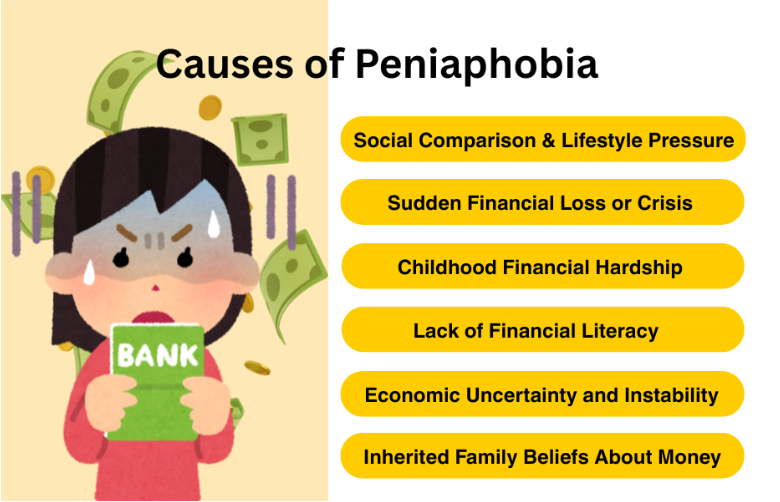
What Are The Causes of Peniaphobia? Why Does Peniaphobia Happen?
The causes of peniaphobia are usually layered, involving early life experiences, significant events, cultural conditioning, and psychological vulnerabilities. Understanding these roots is essential for anyone seeking to address the fear at its core.
Childhood Financial Hardship
One of the most common causes of peniaphobia is growing up in an environment defined by financial instability. Children are remarkably perceptive. Even without adult understanding, they absorb the emotional energy of their surroundings: the tension between parents discussing unpaid bills, the shame of wearing worn-out clothes, the anxiety of not knowing if there will be enough food. These early experiences imprint deeply on the developing nervous system, creating lasting associations between money and danger.
Sudden Financial Loss or Crisis
Experiencing a dramatic financial setback as an adult—job loss, bankruptcy, severe debt, business failure, or sudden medical expenses—is among the most direct causes of peniaphobia. When a person who once felt financially secure suddenly finds themselves unable to pay rent or feed their family, the experience is profoundly destabilising. Even after circumstances improve, the emotional memory of that crisis can persist, keeping the person locked in a state of perpetual vigilance.
Inherited Family Beliefs About Money
Money beliefs are passed down through families just as surely as physical traits. Statements heard repeatedly during childhood, such as "we can never afford anything good," "rich people are dishonest," or "saving is the only way to be safe" become unconscious operating principles. These inherited narratives can fuel financial fear long after the original circumstances that created them have changed.
Fear of Poverty Causes: A Deeper Look
While the roots of peniaphobia are often personal, the broader fear of poverty causes also include societal and systemic factors that affect how people relate to financial security. Understanding these wider influences can help depersonalise the fear and place it in a more accurate context.
Economic Uncertainty and Instability
One of the most significant fears of poverty at a societal level is genuine economic volatility. Inflation, unemployment, rising costs of living, and job insecurity are real threats that make financial anxiety understandable. In India, where economic opportunities can vary dramatically across regions and communities, financial uncertainty is a lived reality for vast sections of the population. When a person's fear is rooted in actual systemic instability, the solution must address both the emotional response and the practical circumstances.
Social Comparison And Lifestyle Pressure
Social media has dramatically amplified the fear of poverty in recent years. When people are constantly exposed to images of wealth, luxury, and apparent success, it becomes easy to feel inadequate and financially behind. In Indian society, where family expectations around marriage, housing, career, and material success can be particularly intense, social comparison contributes significantly to financial anxiety. The sense that one is not measuring up to others' standards fuels shame, which in turn intensifies fear.
Lack of Financial Literacy
Fear often flourishes in the absence of knowledge. Another important fear related to poverty is simply not understanding how money works: budgeting, saving, investing, debt management, and financial planning. When people feel unable to navigate the financial world, uncertainty grows into anxiety. Building genuine financial literacy is therefore not just a practical skill but a powerful tool for reducing fear.
Read our article on peniaphobia vs financial anxiety.
Understanding Money Trauma - What Is It?
Money trauma refers to the lasting psychological and emotional wounds that result from painful or stressful financial experiences. Unlike ordinary financial stress, which tends to be temporary and situational, money trauma creates deep-seated patterns in how a person thinks, feels, and behaves around money, often for many years or even decades after the original event.
Money trauma can originate from growing up in poverty, witnessing intense parental conflict over finances, experiencing sudden financial collapse, living through significant debt or bankruptcy, or being subjected to financial abuse or manipulation within a relationship. In each case, the emotional wounds do not simply heal with time; they become embedded in the person's relationship with money, shaping every financial decision and emotional reaction.
The effects of money trauma are wide-ranging. They can manifest as compulsive spending (using money to soothe emotional pain), compulsive saving (hoarding out of fear), avoidance of finances altogether (ignoring bills or statements due to anxiety), chronic guilt around spending, or an inability to accept financial help or success. In each case, the behaviour is not irrational; it is a learned response to genuine past pain.
How Financial Fear Affects Mental and Physical Health
The impact of chronic financial fear extends far beyond the bank account. When the mind is persistently focused on a threat, even an imagined or exaggerated one, the body responds accordingly. The stress response activates, cortisol levels rise, and the nervous system remains in a heightened state of alert. Over time, this physiological toll takes a serious cumulative effect.
Anxiety and depression are among the most common mental health consequences of financial fear. Relationships suffer as money arguments become a persistent source of conflict between partners and family members. Sleep is frequently disrupted by racing thoughts about finances. In more severe cases, individuals may develop full-blown panic attacks triggered by financial stimuli, such as receiving a bill, visiting a bank, or even hearing a conversation about money.
What Are The Practical Steps Toward Healing from Peniaphobia?
Recovering from financial fear is a gradual process that requires both inner work and practical action. There is no single solution, but a combination of approaches tends to be most effective.
- Name and acknowledge the fear without judgment. Simply recognising that what you are experiencing is peniaphobia, a psychological pattern, not an accurate reflection of reality, can be enormously freeing.
- Examine the roots of your financial beliefs. Where did your ideas about money and poverty come from? Whose voice do you hear when you think about financial security?
- Create a clear, realistic picture of your current financial situation. Fear thrives in ambiguity. Knowing exactly what you earn, spend, save, and owe can reduce anxiety dramatically.
- Build an emergency fund, even a small one. Having even a modest financial cushion can shift the nervous system out of survival mode.
- Practise mindfulness and stress-regulation techniques. Breathing exercises, meditation, and body-based practices help interrupt the anxiety response when it arises.
- Limit social comparison. Curate your social media consumption and remind yourself that other people's financial lives are rarely as they appear.
- Invest in financial literacy. Understanding money reduces fear. Consider taking a financial planning course or working with a trusted financial adviser.
- Seek professional mental health support.
Mental Health Support and Care in India for Peniaphobia
One important and often overlooked resource for those struggling with financial fear is mental health support and care in India. Accessing professional psychological help, whether through therapy, counselling, or psychiatric support, can be transformative for people dealing with peniaphobia and money trauma. Cognitive Behavioural Therapy (CBT) is particularly effective for phobias and anxiety disorders, helping individuals identify distorted thinking patterns and replace them with more grounded, realistic ones. Financial therapy, an emerging field that combines psychological and financial counselling, is also gaining recognition as a powerful approach for healing money-related emotional wounds.
Our Mpower, an Aditya Birla Education Trust initiative offering free and confidential mental health support across India. Their 24/7 toll-free helpline 1800-120-820050 connects callers with qualified psychologists for support with anxiety, low mood, financial stress, and relationship concerns. It is non-judgmental, completely free of charge, and open to anyone above the age of 18. Seeking help for financial anxiety is not a sign of weakness; it is a sign of wisdom.
Final Thoughts
Financial security matters. The desire to protect oneself and one's family from hardship is natural, healthy, and wise. But when fear becomes the primary driver of financial decisions, when anxiety replaces reason, and dread replaces planning, it is time to look more closely at what is really happening beneath the surface.
Money trauma is real, and its effects can be lasting. The fear of poverty is real, and it deserves to be taken seriously—not dismissed, but understood and addressed with care. Whether you are personally navigating these challenges or supporting someone who is, knowing that help exists and that recovery is possible is itself a form of hope.
With greater self-awareness, professional support when needed, practical financial habits, and a compassionate understanding of your own history, it is entirely possible to move from a place of fear to a place of groundedness and genuine financial confidence. The goal is not to never worry about money again; it is to ensure that money no longer holds the power to dictate your sense of safety, worth, and peace.
image credit : freepik

Understanding Substance Abuse: Types, Causes And Warning Signs
Acrophobia - Fear of Heights: Signs and How to Treat It