


How to Control Anger Issues in 5 minutes | Your Anger Management Toolkit
Do you remember the last time your blood boiled?
Perhaps it was a person who was cutting you off in traffic. Or your mother saying that about your marrying, or your co-worker who claims a job you were up for until 2 am finishing. Your jaw clenched. Your heart hammered. Words made in your throat, words which you may repent later on, but which in that instant, quite justified themselves.
Well, this is anger. Anger is a universal, normal emotion. However, when it begins to dictate to you rather than vice versa, when it ruins relationships, impacts your health, or makes you feel powerless, then it is time to form a better relationship with it.
This blog by Mpower, the holistic mental health care provider in India, is your anger management toolbox. Within, there are psychology-supported techniques that take minutes, information on what is actually causing your anger, and tips on how to apply it in any situation: family, work, relationships, and even Indian roads. Let's begin.
What Is Anger? (The Clinical Definition)
According to the definition of the American Psychological Association, anger is a state of emotion that can range from mild irritation to fierce fury and rage (Spielberger, as cited in APA, 2023). As any other emotion, it is accompanied by physical alterations: your heart rate and blood pressure increase, your body secretes adrenaline and cortisol, and you are ready to act.
It is your old brain working. Anger developed out of self-defense, to fight back when threatened, to protect our own land, and to warn that something is amiss. In that sense, anger isn't bad. It's information.
Healthy anger notifies you of injustice, encourages you to establish limits, and safeguards you against harm. Whereas, problematic anger occurs when the response is excessively strong, too common, or manifested in a manner that is harmful to you or other people. Once anger is destructive (i.e., causing aggression, broken relationships, or other physical manifestations), it needs to be addressed.
Visit Mpower to manage your anger issues in a better way.
The Psychology of Anger: What Makes Us Blow It Out?
The first thing to control anger is to know why it occurs.
1. The Fight-or-Flight Response:
There is no distinction between a social threat (an insult) and a physical threat (a tiger) to your body. When you are provoked, your amygdala, the alarm system of your brain, raises your sympathetic nervous system. Adrenaline surges. Muscles tense. You're ready to fight.
The problem? In the contemporary world, life is loaded with stimuli in which fighting is inappropriate and unhelpful. It is like, on a team meeting or family dinner, your body is ready to fight, and you are left with this burst of energy, and nothing to put it to.
2. Cognitive Behavioral Theory:
It is not the Incident, it is the Idea. Cognitive Behavioral Therapy (CBT) is one of the most helpful frameworks in understanding anger. The essence is very straightforward: it is not the situation itself that will make you angry - it is what you say to yourself about the situation.
This model was named the ABC model by psychologist Albert Ellis:
- Activating event: a person cuts you off on the road.
- Conclusion: 'That was intentional by that jerk! He has no respect for anyone!'
- Result: Raging anger, honking, screaming.
Suppose now we ask ourselves to think the same thing, a different belief: 'Or perhaps he is going to the hospital. Maybe his wife is in labor. Perhaps he simply received some bad news: same incident, totally different response.
It is not about being a doormat. It is about realizing that your thoughts make your feelings - and that you can be found out in your thoughts.
3. The Anger Iceberg:
Here is one metaphor that alters all things.
Imagine an iceberg. The tip- the one that is out of water- is anger. But concealed, beneath the surface, are all the feelings anger guards us against feeling:
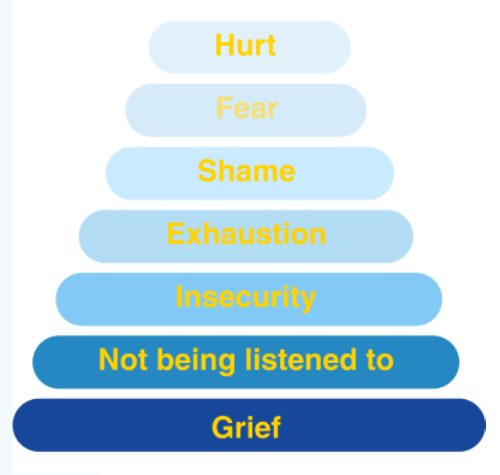
Real-life example: A 35-year-old marketing manager called Kavita (changed). She was shouting at her mother every day, at food, at remarks, at everything. During therapy, she discovered what was under it: grief. Her father had died two years ago, and she had never really gotten over it. Her mother was a catalyst to that feeling of pain, which was not to be spoken of, and anger was the mouthpiece.
The second question is, next time you are raging, look back at yourself: What am I feeling underneath this?
4. Where Have You Learned to Be Angry? (Social Learning Theory)
By observing adults, psychologist Albert Bandura demonstrated that children acquire emotional responses. Consider your family as a child:
- Was it usual to yell during conflict situations?
- Was the silent treatment one of punishment?
- Was it anger that was repressed absolutely - no good people get angry?
- In case anger was the default reaction in your family, then you probably internalized those patterns. The good news? What is learned may be unlearned.
Why Are Hot-Headed People More So?
Psychologist Jerry Deffenbacher, PhD, says that there is some truth that certain individuals are more dispositionally angry. They possess so-called low frustration tolerance, a feeling that they do not need to face inconvenience, wait, or be irritated (APA, 2023).
This can stem from:
- Genetic or physiological causes (some children are born more irritable)
- Disorganized or emotionally inept family backgrounds.
- Social-cultural messages, which do not encourage healthy emotional expression.
This is not about blame. It's about awareness. And conscious thought is the place to start.
Your 5 Minutes of Anger Management Kit
So, onto what you came here now: the tools that are working in minutes. You will see that the strategies are based upon psychology, neuroscience, and clinical practice, and they are made to work at the time when you need them most.
1. The 3 - Second Pause:
Keep counting to three when you are angry. That's it.
The reason behind this is as follows: the initial burst of cortisol and adrenaline takes about three seconds to begin fading. The three seconds there make a space between impulse and action - the space in which choice is.
How to do it:
- When anger is emerging in you, stop.
- Breathe in through the diaphragm (not through the chest).
- Count: one, two, three.
- Then decide what to do next.
2. The STOP Technique (From DBT)
This is of Dialectical Behavior Therapy, and it is a lifesaver in a hot situation:
- Stop: Freeze. Don't move. Don't react.
- Breath: Breathe: One deep breath, right up to the bottom.
- Observe: What are you feeling? What are you thinking? What's happening in your body?
- Be careful: Select your response deliberately.
3. Physical Distance Strategy
This, it is almost too good to be true: step away. Literally.
- When you are fighting with your wife, go out to the balcony. Bathroom break when you feel passionate at work. When a family meeting is too intense, go outside.
- Why it works: Physical distance engages the prefrontal cortex, which is your brain's thinking center, and also helps the amygdala relax. Then, after one moment, you are able to see the entire picture rather than the moment.
4. The Tongue - to - Roof Trick
This is an unpopular yet effective method. When you are getting angry, use your tongue and press it against the roof of your mouth for 10 seconds.
How it works: This is a physical activity that disrupts the brain circuits of reactivity. You can hardly remain angry when you are concentrating on a bodily feeling. It gives your logical mind time to get run to.
5. Temperature Change
Pour cold water over your face. Hold an ice cube. When you are at home, have a cold shower.
Why it is effective: Cold water causes the so-called mammalian dive reflex- a physiological mechanism that makes your heart beat slower and diverts blood to the vital organs. It literally reduces the temperature of your nerves.
6. The 5-4-3-2-1 Grounding Technique (Mindfulness activities)
It is a method that makes you stop thinking about rage within you and start thinking about reality in the world where you live:
- Name 5 things you can see
- Name 4 things you can touch
- Name 3 things you can hear
- Name 2 things you can smell
- Name 1 thing you can taste
- When you get to one, your anger has, as a rule, diminished.
7. The Commentary Trick (Especially on the Road Rage)
This one has been modified for the Indian roads. Instead of swearing at the driver who has just run you off, describe it as a cricket announcer:
'There comes the red Maruti, without warning, taking a daring step. Interesting tack, on the part of the young batsman - we will see how this comes. The crowd is not impressed'.
Why it is effective: Humor establishes cognitive distance. You no longer find yourself in the middle of the drama, but you are outside of it. And observation is ever milder than participation.
B. Controlling Anger Problems in The Family
The category of family anger is also special. The ones we most love may provoke us the most as well - the stakes are greater, the history more extensive, and it is not always possible to get out.
The Dynamic Uniqueness of Indian Families.
Boundaries in most Indian families are loose. Several generations are cohabiting. We all have a feeling about all things: your career, your marriage, your eating habits, and your choice of life. Intrusion and love tend to go hand in hand.
This tight space relationship implies that anger builds up at all times. The uncle who compliments about your weight. The mother who compares you to that of the neighbor. The wife who leaves wet towels in bed.
The Tactical Break in the Argumentation
During an argument in the family, say the following: I need five minutes to think about this.
This isn't giving up. It's emotional maturity. It is saying, I treasure this relationship so much that I would not risk saying something I would regret.
Establish a code word with the family members, something neutral, like red light or pause, that will make you aware that someone is in need of a break.
Use 'I' Statements vs. 'You' Accusations
Notice the difference:
'You always interrupt me!' - Attack, accusation, blame.
I feel that I am not heard when there is a fast pace of conversation in the group, so I cannot contribute. - elucution, exposure, entreaty.
The latter one is more difficult to disagree with. It does not attack it, but rather shares.
Breaking The Generational Patterns.
Real life: Arjun is 42 years old, and he is a father who has been screaming at his 10-year-old son because of spilling milk. At that time, he heard the voice of his father, out of his own mouth - the same voice, the same words. It terrified him.
It is the turning point of the moment of recognition. Arjun started to receive therapy, got acquainted with new tools, and gradually, albeit not perfectly, started a cycle that had been occurring in his family for generations. You can never alter your place of origin. But you can switch where you are going.
When Family Members Mean to Push Your Buttons.
There are those individuals who appear to have a clue about what buttons to press, including people they love. Under such circumstances, resort to the grey rock technique.
Turn into a grey rock: dull, unresponsive, unreactive. Don't provide them with the emotional fuel that they seek. Be polite but disengaged. Over time, they'll stop trying.
C. Control Anger at Work (Without Being Fired).
Anger in a workplace is a unique monster. You cannot shout at your boss, even when he or she deserves it. You cannot even bottle it up.
How to Respond to Anger Professionally?
When a person demoralises you during a meeting or claims to have done your job, you should fight not to respond immediately. Instead, I would like to talk about the project we have just discussed. What is a good time to make a connection?
This will allow you time to relax, and it is a sign of professionalism. The other individual was anticipating anger; you have provided him with composure.
Use The Bathroom Break Strategy
The strength of a bathroom break should never be underestimated. It is the only place you can just go without a word. Use those few minutes to:
- Breathe deeply
- Splash water on your face
- Repeat a calming phrase
- Remember that you make your money by keeping your head.
The 'Two-Email' Rule
You are angry about an email, write back a reply- save it in a draft. Wait at least 30 minutes. Review it with fresh eyes. Angry emails must never be sent out 90 percent. Those who pass the 30-minute test are usually more balanced, more professional, and more productive.
D. Road Rage: How to Manage Road Rage When Driving.
As you have driven in any Indian city, you are well aware of the fact that road rage is almost inevitable. The commute, the honks, the drivers who make lanes a recommendation, it is a storm that could make a person rage.
The Reason Indian Roads cause Rage.
- Full streets without personal space.
- Irresponsible driving by others.
- The anonymity factor: we depersonalise other drivers.
- The necessity to hurry somewhere.
The Commentary Technique (Expanded)
Go a step further with the cricket commentator. Assign each driver a history:
Oh, it is the white SUV: obviously, a high-level employee who is late to a business meeting. The blue automobile, a soul of the philosophy, not disturbed by a road or a light.
It is ridiculous, though, and ridiculousness diffuses anger. You can not remain in a fury when you are mentally reading a comedy.
The Driving Mantra
Develop a short saying to say when you feel frustrated:
- 'I shall come safely, not only swiftly.'
- 'They are all trying to go somewhere, just like me.'
- 'This moment will pass'.
The 'Everyone's Human' Reframe
That driver who cut you off? Maybe his wife is in labor. Maybe he just lost his job. Maybe his child is sick. This does not justify careless driving. Yet it changes your mind to thinking this is not a personal attack, but rather a complex world, full of struggling humans. And that change must put your anger down.
E. Rage in the Digital Era: Anger in the Post-Pandemic Reality
The anger of 2026 is not the same as in 10 years ago.
The Rage Machine of Social Media
Algorithms are made to ensure that you remain interested, and nothing makes you remain interested more than outrage. Twitter fights, comment section battles, the never-ending feed of other people's highlight reel it produces a kind of low-grade annoyance that was not present previously.
Digital hygiene tips:
- Silence notifications when spending time with the family.
- Limit social media to 30 minutes a day.
- Do not ever read remarks when you are already angry.
- Keep in mind: Ultimate battles over the Internet have no winners.
Post-Pandemic Short Fuses
We are all lugging around additional emotional baggage. The seclusion, health panic, and economic ambiguity it has made a lot of us shorter-tempered.
WFH has destroyed boundaries. Partners interrupt calls. Children interrupt video conferences. No ride back home to unwind after work and family. Couples who spent 8 hours apart have become inseparable 24/7, thus creating friction over small issues.
It is not only you, but if you are angrier, on the whole, now than you were 5 years ago. The world has changed. Be gentle with yourself.
Myths vs. Facts about Anger
| Myth | Fact |
|---|---|
| 'Venting helps you release anger and calm down.' | Studies indicate that venting actually increases anger and aggression. It is akin to pouring fuel on a fire (APA, 2023). |
| 'Anger is a bad emotion; 'nice' people don't get angry.' | Anger is a normal and valid emotion. What matters is not the feeling itself, but how you choose to express it. |
| 'To get what you want, you must be angry or aggressive.' | Assertiveness-expressing needs respectfully-does not require aggression or putting others down.' |
| 'Some people are just born angry; it's in their nature.' | While temperament plays a role, anger patterns are adjustable. The brain is not 'hardwired'; it can be trained to respond differently. |
| 'Counting to ten is a useless cliché.' | It is effective when combined with deep breathing. That brief interval provides the necessary time to choose a response rather than reacting impulsively. It works in the case of impulsive thoughts. |
In case your anger is causing violence, scaring others, upsetting work or relationships, and is uncontrollable in spite of your efforts, it is time to talk to someone. Like a therapist with techniques like CBT that change angry thoughts, DBT develops emotional management, Trauma therapy that heals the past, & Family therapy heals relationships. Such organizations as MPOWER provide sympathetic care. You do not need to work this out by yourself.
You Are Not Your Anger
Your anger is not who you are. It is an accuser - indicating pain, terror, fatigue, or unfairness under the thumb. It is not about being able to never feel angry, but rather about making a distance between the anger and your reaction.
There are days when you will lose your temper. That's being human. The thing is, the next thing you must do. Start small. Choose one device: the 3-second pause, STOP technique, or commentary trick, and attempt it this week. Just one. Since each little gain is a gain toward a cooler, freer you. And you deserve that. A moment, a single breath, a decision.
Conclusion
In the end, anger isn't something you need to eliminate - it's something you need to understand and manage. With the right tools, even a few mindful minutes can create the space between impulse and response, helping you protect your relationships, your peace, and your well-being. Start small, stay consistent, and remember: every time you choose calm over reaction, you take back control.
image credit : freepik

Understanding Substance Abuse: Types, Causes And Warning Signs
Acrophobia - Fear of Heights: Signs and How to Treat It