


Top 20 Ways to Stop Overthinking - How to Stop Overthinking
Summary -
To stop overthinking, identify your thought triggers, practice mindfulness, challenge negative thoughts, focus on what you can control, set decision deadlines, write your thoughts down, exercise, practice deep breathing, limit information overload, accept uncertainty, and take action. Building healthy routines, avoiding comparisons, talking to someone you trust, practicing gratitude and relaxation, seeking professional help when needed, and being patient with yourself can also help reduce overthinking and develop healthier thinking habits.
Introduction
Have you ever been stuck thinking about a certain situation over and over again that you can't change? Have you struggled with a decision you made in the past, one you need to make now, or something else that keeps circling in your mind? If so, you're definitely not alone. In actuality, everyone goes through this experience in life. This kind of behavior is termed overthinking. It can affect your relationships, make it harder to focus on your work, and cause you to constantly doubt yourself, gradually reducing your self-confidence.
Understanding the meaning of overthinking and how you can stop overthinking is the first step to kicking this habit for good and learning how to think positively for the rest of your life.
This guide shares 20 practical ways to help you stop overthinking, reduce stress, and take control of your thoughts.
What Is Overthinking?
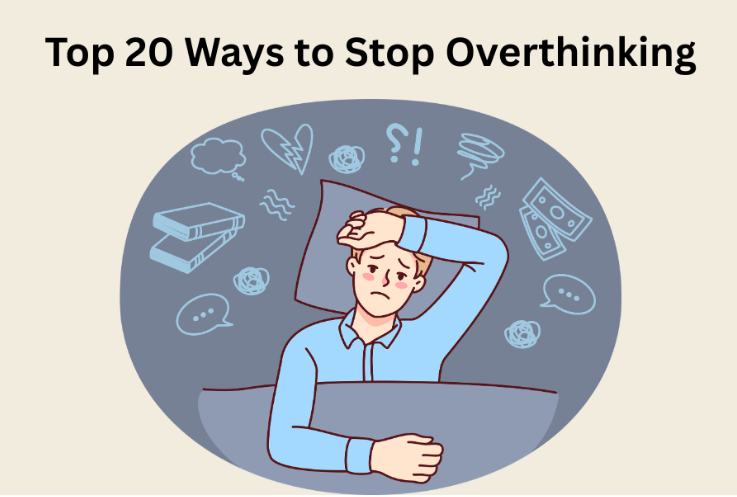
Overthinking is when you keep thinking about a situation, conversation, or decision long after it has happened or one you need to make now. Instead of helping you solve the problem, your mind keeps going back to the same thoughts. You replay different situations, question your decisions, and wonder what you could have done differently. As a result, finding a solution becomes even more difficult.
The biggest difference between healthy thinking and overthinking is simple:
- Healthy thinking helps you understand a problem and find a solution.
- Overthinking keeps you stuck in the same cycle of worry without helping you make progress.
In simple terms, the Overthinking meaning is repeatedly dwelling on thoughts, situations, or possibilities until they begin to affect your emotional well-being and daily life. Once you understand this pattern, it becomes easier to recognize when you're overthinking. Understanding the meaning of overthinking early can help you recognize unhealthy thinking patterns before they become a habit.
What Are The Signs of An Overthinker?
The earlier you can detect overthinking, the sooner you can take back control before stress interferes with your quality of life.
Here are some of the typical signs of overthinking:
- Replaying old conversations all the time
- Thinking about worst-case scenarios that aren't necessarily based on reality
- Having difficulty making even the most straightforward decisions
- Loss of sleep due to ruminations
- Always seeking reassurance
- Feeling mental fatigue in normal situations
- Difficulty concentrating
- Fearing mistakes
- Interpreting facial expressions
- Postponing decisions as nothing feels "right"
If these behaviors sound familiar, it's time to start learning how to stop overthinking before these habits begin affecting your confidence, productivity, and emotional health.
Is There Such A Thing as An Overthinking Disorder?
Many people use the term Overthinking disorder to explain excessive worrying, but it is not actually a thing. Overthinking is a symptom of some mental illnesses such as generalized anxiety, depression, OCD, and stress.
That does not mean that you should ignore your overthinking, because it can definitely affect your work, relationships, sleeping pattern, and happiness. If your overthinking is hindering your daily life or if it is out of your control, it is always a good idea to pay a visit to the doctor or to seek professional help.
Why Do People Overthink?
In most cases, it develops as a response to uncertainty, fear, or past experience. The brain seeks safety, and when situations feel unpredictable, it tries to analyze every possible outcome.
Some of the most common causes include:
- perfectionism
- anxiety
- low self-esteem
- past disappointments or trauma
- fear of rejection
- high expectations
- fear of the unknown and uncertainty.
For example, someone preparing for an interview may spend hours imagining every possible question instead of simply practicing confidently. Likewise, students often replay exam answers long after leaving the examination hall, even though nothing can be changed.
Understanding the root cause of your thoughts helps you choose the right Overthinking solution instead of simply trying to ignore your worries. Addressing the cause is always more effective than fighting the symptoms alone.
How to Stop Overthinking: 20 Practical Ways
The top 20 practical ways to stop overthinking are as follows -
Identify Your Thought Triggers
The very first thing that you need to do in order to learn how not to overthink is to recognize the reasons why you overthink. You need to focus on those cases when you overthink more than usual. These cases may include:
- Criticism
- Uncertainty
- Some person
- Certain situations
- Difficult conversations
- Important decision-making
A journal can help reveal these patterns, which is one of the most practical ways to learn how to stop overthinking, because it addresses the problem before it grows.
Practice daily mindfulness
Mindfulness is being aware of what's going on around you in the present moment. Practicing mindfulness can be achieved through the following activities:
- Mindful breathing
- Walking
- Meditation
Practicing for five to ten minutes every day is enough to train your brain to observe thoughts without getting caught up in them. Making mindfulness a daily habit can also help you learn how to stop overthinking more effectively.
Challenge Negative Thoughts
It's important to realize that not all the thoughts we think are true. Whenever you feel negative about something, try taking a few moments to analyze whether the thought is based on facts or your imagination. Most of the fears we experience are simply assumptions; they are not true at all. Using realistic thoughts instead of negative thoughts is one of the best overthinking solutions out there.
Focus on What You Can Control
A lot of people waste their time and energy trying to influence things they can't control. Instead of putting effort into controlling the opinions of others, focus on the things that are in your power. Preparing for an outcome, communicating your position, and making an informed decision are examples of things you can control. Learning to focus only on what you can control is an important step in how to stop overthinking and reduce unnecessary stress.
Set Deadlines for Yourself
If you take too long on decision-making, set yourself deadlines. Give yourself a few minutes to make smaller decisions and more time for larger decisions. Remember that perfection does not exist, and it is better to act than overthink things.
Write Things Down
Keeping a journal to write down what is going on in your head will make you see your problems and feelings more clearly and allow you to separate facts from assumptions and negative thinking.
Do Some Physical Exercise
Exercising will relax you both physically and mentally and decrease your stress levels. Try some physical activities such as:
- Walking
- Running
- Cycling
- Yoga
- Gym workouts
Even 20-30 minutes a day can make a difference.
Practice Deep Breathing
Deep breathing is a simple practice to ease your mind when you are stressed. Just take deep breaths for a few minutes to relax your body and stop overthinking.
Limit Your Information Input
Too much information can overwhelm your mind. Try to reduce unnecessary exposure to:
- Social media
- News channels
- Negative conversations
Taking regular breaks helps your mind relax and focus on what truly matters.
Stop Striving for Perfection
Trying to be perfect all the time can lead to stress and self-doubt. Accept that mistakes are a normal part of life and focus on progress instead of perfection.
Learn to Live With Uncertainty
There is no point in controlling everything and being able to forecast your future. The ability to accept uncertainty will help you stay calm. It is a good Overthinking solution as well as a way to stop overthinking and also an important step in learning how to stop overthinking
Think Less, Act More
Instead of thinking about every possible outcome, take one small step. Whether it's sending an email, making a plan, or starting a task, action helps break the cycle of overthinking. Remember, nothing is ever perfect, and taking action is better than overthinking.
Create a Healthy Routine
A healthy routine will decrease stress levels and keep your mind balanced. Here is what you should do:
- Go to bed at an appropriate time
- Consume healthy food
- Be active
- Schedule your day
Small routines will allow you to easily learn to stop overthinking. Following a healthy routine every day is also an effective Overthinking solution for reducing unnecessary stress.
Do Not Compare Yourself to Other People
Everybody has their own story and experience. Comparing yourself to other people, especially on social media, may have negative consequences. It is better to focus on yourself and spend more time doing what pleases you.
Discuss Your Feelings with Someone You Trust
You can feel relief by discussing your thoughts and feelings with a friend, family member, mentor, or therapist. Sometimes just speaking about your problems can be helpful.
Be Grateful
Spend a few minutes every day thinking about all the positives in your life. You can keep track of them by writing down the following things:
- Your family
- Healthy body
- Great friends
- Little victories
Practicing gratitude is an easy way of stopping overthinking.
Take Good Care of Your Health
Self-care is vital for maintaining mental well-being. Ensure that you:
- Sleep well
- Feed your body with nutritious foods
- Exercise regularly
- Take breaks whenever necessary
A healthy body means a healthy mind.
Practice Relaxation Techniques
There are several relaxation techniques that may help ease your mind and lower levels of stress. These include:
- Meditation
- Yoga
- Breathing exercises
- Listening to soothing music
- Progressive muscle relaxation
Even 10-15 minutes daily makes a huge difference.
See a Mental Health Professional
If overthinking influences your life negatively, see a mental health professional for proper assistance and treatment. Seeking help shows courage.
Be Patient With Yourself
Stopping overthinking requires time. There will be some good and some bad days, and that's fine. Celebrate even the tiniest successes and know that each step counts.
What Is the Right Solution for Overthinking?
No universal Overthinking solution is applicable to all people. Each person should choose the best techniques that will be helpful in their particular case. Selecting the correct Overthinking solution according to individual needs will make the process of managing thoughts easier.
How Can You Stop Overthinking and Thinking Negatively?
Learning how to overcome overthinking and negative thoughts means comprehending that not all thoughts are true. While having negative thoughts, you have to understand whether these thoughts are facts or just your fears. It is necessary to concentrate on the development of habits such as gratitude, mindfulness, physical exercise, and communication with someone you trust.
Please note that overcoming overthinking and negative thoughts is a time-consuming process. Being patient, consistent, and developing healthy habits will allow you to train your brain to react more calmly to stressful situations.
Conclusion
Overthinking is one of the things that can seem to be an impossible activity. In order to get rid of this problem, there is a need to understand the meaning of overthinking, and following these practical tips will help you learn how to stop overthinking, reduce stress, and build healthier thinking habits over time. There is a need for you to understand this concept and be able to improve upon your thinking process each and every day. With that in mind, it is necessary that you do not lose hope. It will not be easy, but you can conquer it.
image credit : freepik

Understanding Substance Abuse: Types, Causes And Warning Signs
Acrophobia - Fear of Heights: Signs and How to Treat It